Creating a living screen requires more than just digging a series of holes and dropping in root balls. When homeowners approach a landscape project involving privacy screening, they often prioritize immediate density over long-term horticultural health. This specific tension between instant gratification and sustainable growth is the primary hurdle in mastering Arborvitae Privacy Hedge Spacing. A poorly spaced hedge will eventually compete for limited nutrients, light, and water, leading to “thinning out” at the bottom or the dreaded browning of interior needles. Successful integration of these conifers into your property enhances curb appeal and provides a natural sound barrier, but it demands a deep understanding of the specific cultivar’s mature width and the local microclimate. Whether you are dealing with the narrow profile of the Emerald Green or the explosive growth of the Green Giant, the architectural integrity of your outdoor space depends on precision at the planting stage.
Landscape Design Principles
In professional landscape architecture, we view the privacy hedge as a “green wall” that functions as the backdrop for all other garden elements. To achieve a balanced aesthetic, you must consider symmetry and the existing sightlines of the property. If the hedge is placed along a retaining wall, the elevation change must be factored into the spacing; plants at a higher elevation will naturally catch more wind and sun, potentially requiring wider spacing to allow for airflow.
Symmetry does not always mean a straight line. In modern landscape design, we often use a staggered or “zigzag” planting pattern. This technique provides immediate privacy by overlapping the foliage of two rows while giving each individual tree more room for its root system to expand. When planning your layout, consider the focal points of the yard. A hedge should guide the eye toward a specific feature, such as a stone walkway or an outdoor kitchen, rather than simply acting as a blunt boundary.
Furthermore, irrigation planning must be integrated into the initial design phase. A hedge is a high-density planting that creates a massive collective demand for moisture. We recommend a drip irrigation system installed beneath a layer of shredded hardwood mulch. This ensures that water reaches the root zone directly without keeping the foliage perpetually damp, which can invite fungal pathogens. By aligning your tree placement with your irrigation lines, you ensure that every specimen in the line receives an equal share of resources, maintaining a uniform height and color across the entire screen.
Plant and Material Selection
The following table outlines the most common selections for privacy screens. Choosing the right cultivar is the first step in determining your Arborvitae Privacy Hedge Spacing.
| Plant Type | Sun Exposure | Soil Needs | Water Demand | Growth Speed | Maintenance Level |
| :— | :— | :— | :— | :— | :— |
| Emerald Green (Thuja occidentalis) | Full Sun | Well-drained | Moderate | 6-12 inches/year | Medium |
| Green Giant (Thuja standishii x plicata) | Full/Partial Sun | Adaptable | High | 3-5 feet/year | Low |
| American Pillar | Full Sun | Moist/Rich | Moderate | 2-3 feet/year | Medium |
| Nigra Arborvitae | Full/Partial Sun | Loamy | Moderate | 1 foot/year | Low |
| Techny (Mission) | Full/Partial Sun | Heavy Clay/Loam | Moderate | 1 foot/year | Low |
Implementation Strategy
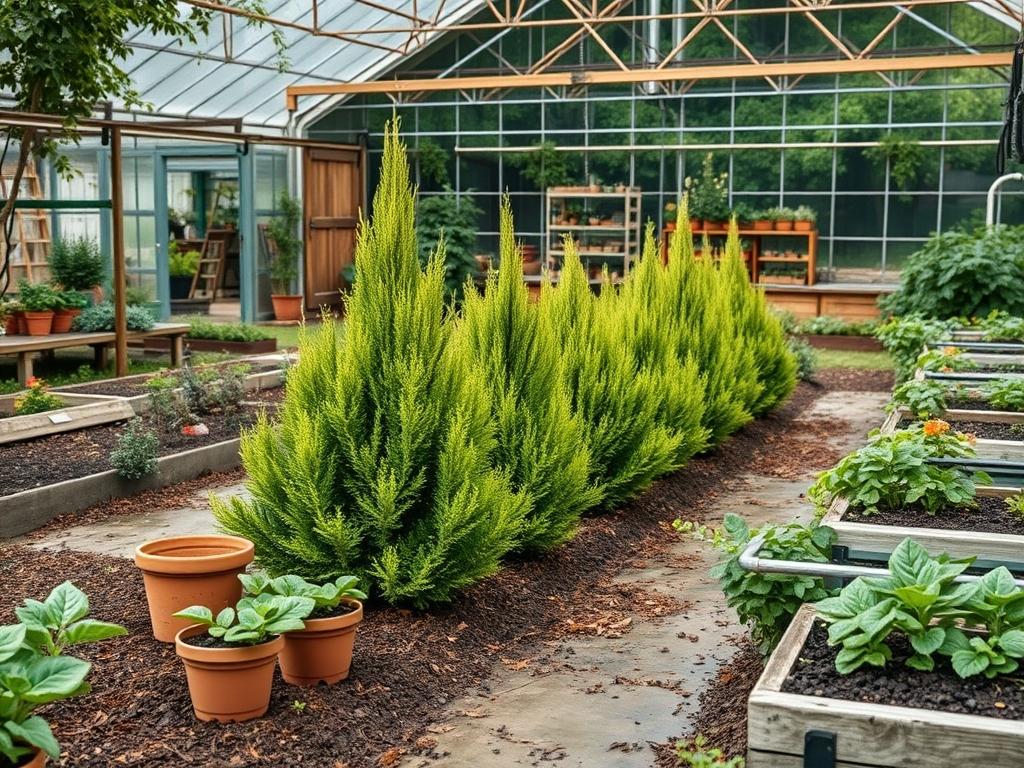
The successful installation of a privacy screen begins with accurate site grading. Before any trees arrive on site, the area must be leveled or sloped appropriately to prevent water from pooling at the base of the root balls. Once the grade is established, mark your centerline using a string line and surveyor’s stakes. For a standard Emerald Green hedge, a spacing of 2 to 3 feet on center is the industry standard. If you are planting Green Giants, increase this to 5 to 6 feet on center to account for a mature spread that can reach 15 feet.
After marking the locations, excavate a trench rather than individual holes if the soil is compacted. This allows the roots to spread laterally into loosened soil more easily. The depth of the trench should be no deeper than the height of the root ball; planting an arborvitae too deep is a leading cause of trunk rot. As you backfill, use a mixture of native soil and a small amount of composted organic matter.
Once the trees are set, install a metal or heavy-duty plastic edging to define the bed and prevent turf grass from encroaching on the trees. Apply a 3-inch layer of mulch across the entire bed, but keep the mulch an inch or two away from the actual trunks. This layer regulates soil temperature and retains moisture, which is critical during the first two growing seasons. Finalize the installation with a deep “soaking” to settle the soil and remove any air pockets around the roots.
Common Landscaping Failures
The most frequent error we see in the field is root overcrowding. When trees are planted too close together in an attempt to get a “solid wall” by the first summer, they eventually begin to shade each other out. This lack of sunlight causes the lower branches to die off, leaving a bare, spindly bottom that defeats the purpose of a privacy screen.
Drainage mistakes also rank high among common failures. Arborvitae are susceptible to “wet feet,” a condition where the roots sit in standing water and eventually decay. If your soil remains saturated for more than 24 hours after a heavy rain, you must install French drains or elevate the planting bed into a slight mound to move water away from the root zone.
Finally, overlook of soil compaction during construction is a silent killer. Heavy machinery used for hardscaping or retaining wall installation often packs the soil so tightly that roots cannot penetrate it. If you are planting in a high-traffic or recently built area, use a broadfork or mechanical aerator to loosen the subsoil before planting. Failure to do so will result in stunted growth and a hedge that never reaches its full potential.
Seasonal Maintenance
Seasonal care is what separates a professional landscape from a neglected one. In the Spring, your focus should be on fertilization and inspection. Apply a balanced, slow-release fertilizer before the first flush of new growth. This is also the time to check for bagworms or spider mites, which can devastate a hedge if left unchecked.
During the Summer, irrigation is the priority. During heatwaves, a mature arborvitae hedge may need deep watering two to three times per week. Monitor the color of the needles; a dull, grayish-green hue is often the first sign of drought stress. Avoid heavy pruning during the hottest weeks, as this can sunburn the newly exposed interior foliage.
In Autumn, focus on hydration and protection. Evergreen needles continue to transpire (lose water) throughout the winter, so it is vital that the trees go into the frozen months fully hydrated. Apply a fresh layer of mulch to insulate the roots. This is also the best time for structural pruning to remove any multi-leader stems that might split under heavy snow.
Winter maintenance involves protecting the physical structure of the trees. In regions with heavy snowfall, use burlap twine to lightly wrap the tops of narrower cultivars like the Emerald Green. This prevents the heavy snow from bending the branches outward, which can permanently deform the tree’s columnar shape. If a heavy snow does fall, gently brush it off the branches with an upward motion.
Professional Landscaping FAQ
What is the ideal distance from a fence for arborvitae?
Plant your arborvitae at least 3 to 4 feet away from a fence line. This allows enough space for the tree to expand without pressing against the structure, which can cause rot and prevent you from performing necessary maintenance or painting.
How do I calculate how many trees I need?
Measure the total linear footage of the area. Divide that number by your chosen “on center” spacing. For a 60-foot run with Emerald Greens spaced 3 feet apart, you will need exactly 20 trees to complete the screen.
Can I mix different varieties in one hedge?
While possible, it is not recommended for a formal privacy screen. Different cultivars grow at different rates and have varying shades of green, which creates an uneven, disorganized appearance. Stick to one cultivar for a clean, professional aesthetic.
Why are the bottoms of my arborvitae turning brown?
This is usually caused by either salt damage from winter roads or a lack of sunlight. If the trees are spaced too closely, the lower limbs cannot photosynthesize. Ensure adequate Arborvitae Privacy Hedge Spacing to allow light to reach the base.
When is the best time of year to plant a hedge?
The ideal windows are early Spring, after the ground thaws, or early Autumn, at least six weeks before the first hard frost. These periods allow the root system to establish without the extreme stress of summer heat or frozen soil.