
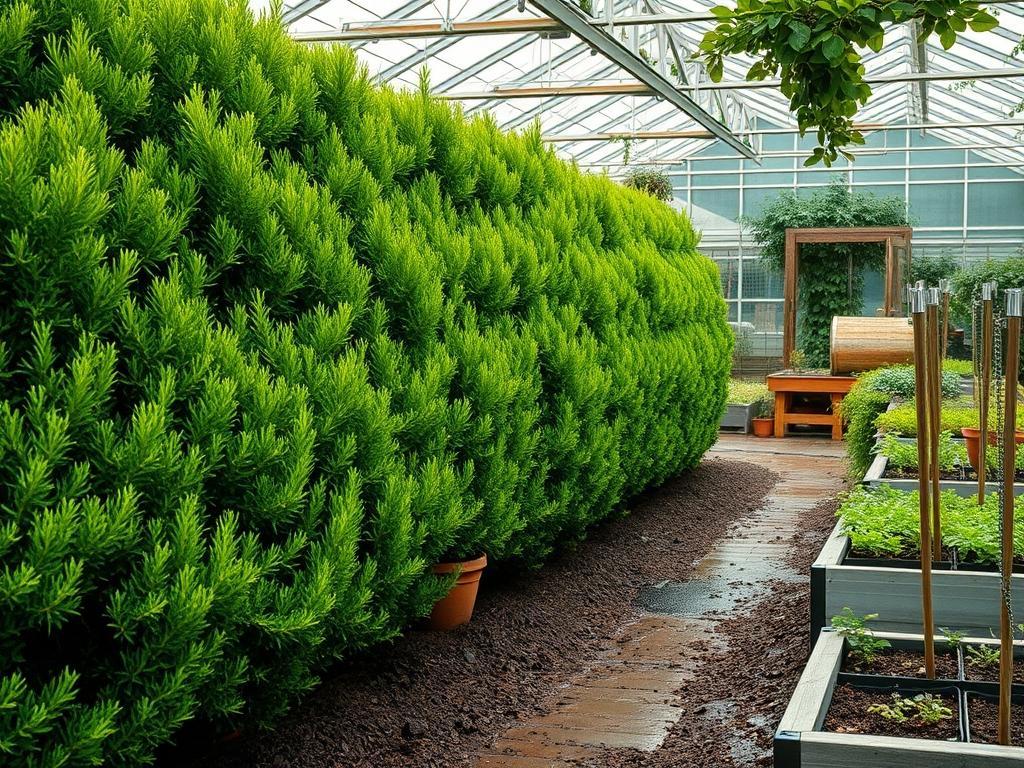
Achieving a flawless privacy screen requires an understanding of both biological growth patterns and architectural geometry. In the realm of high-end landscape design, the yew serves as the premier choice for creating living walls that define outdoor “rooms” and establish clear property boundaries. Unlike many faster-growing conifers that become leggy and thin over time, the yew offers a dense, fine-textured foliage that can be sculpted into near-perfect geometric forms. This technical process, often referred to as Yew Privacy Hedge Trimming, involves more than just a surface-level haircut. It is an exercise in managing light penetration, nutrient distribution, and structural integrity. For homeowners in temperate climates, the yew is particularly valuable due to its tolerance for shade and its remarkable longevity. A well-maintained hedge can last for centuries, providing a permanent backdrop that enhances curb appeal and increases property value. The goal is to create a seamless transition between the built environment and the natural landscape, ensuring that the hedge functions as a functional acoustic barrier and a visual anchor for the entire garden design.
Landscape Design Principles
Successful garden planning begins with the principle of spatial hierarchy. A yew hedge acts as the “walls” of the outdoor environment, providing the necessary enclosure to make large spaces feel intimate and small spaces feel structured. To achieve professional visual balance, architects often utilize the concept of symmetry, particularly in formal English or French garden styles. When planning the placement of a hedge, one must consider the sightlines from both the interior of the home and the primary outdoor lounging areas. A hedge that is too tall can feel oppressive, while one that is too short fails to provide the requisite privacy.
Elevation layers are another critical consideration. The yew hedge represents the “backstage” of the garden. In front of this dark green canvas, designers typically place mid-level shrubs and foreground perennials to create a sense of depth. This creates a tiered effect that draws the eye upward and outward. Walkway planning must also account for the eventual mature width of the hedge. A common mistake is planting too close to a path, necessitating aggressive pruning that can damage the plant’s health. By leaving a minimum of 24 inches between the center of the plant and the edge of a walkway, you ensure the hedge has room to swell without obstructing foot traffic. Furthermore, focal points such as stone statuary or water features are often placed at the terminus of a yew-lined corridor to provide a destination for the eye, reinforcing the garden’s intentionality and flow.
Plant and Material Selection
| Plant Type | Sun Exposure | Soil Needs | Water Demand | Growth Speed | Maintenance Level |
| :— | :— | :— | :— | :— | :— |
| Taxus baccata (English Yew) | Full Sun to Full Shade | Well-drained, Alkaline | Moderate | Slow | High (Technical) |
| Taxus x media ‘Hicksii’ | Full Sun to Part Shade | Loamy, Moist | Moderate | Medium | Medium |
| Taxus x media ‘Densiformis’ | Full Sun to Shade | Neutral pH | Low to Moderate | Medium | Low |
| Taxus cuspidata (Japanese Yew) | Part Shade | Rich, Acidic to Neutral | Moderate | Slow | High |
| Taxus canadensis (Canada Yew) | Deep Shade | Moist, Acidic | High | Slow | Low |
Implementation Strategy
The foundation of a successful yew hedge lies in the preparation of the planting trench rather than individual holes. A continuous trench, approximately 36 inches wide and 18 inches deep, allows for uniform root expansion and consistent drainage across the entire span. Grading is the first technical step. The soil should be slightly mounded or “crowned” along the center of the trench to prevent water from pooling at the base of the stems, as yews are highly susceptible to Phytophthora root rot.
Once the trench is excavated, incorporate a mix of organic compost and aged pine bark to improve soil structure. Edging is then installed to create a clean break between the hedge bed and the lawn, prevent turf grass from competing for nutrients. For the irrigation system, a 1/2-inch drip line with emitters spaced every 12 inches is the most efficient method, delivering water directly to the root zone while keeping the foliage dry. After planting the root balls, apply a 3-inch layer of double-shredded hardwood mulch. This mulch depth is specific; too thin and it fails to suppress weeds, too thick and it may suffocate the surface roots. If the site requires a retaining wall for leveling, ensure that the wall includes weep holes for drainage, as the trapped moisture behind a wall will quickly kill a Taxus species.
Common Landscaping Failures
The most frequent error in Yew Privacy Hedge Trimming is the failure to account for sunlight distribution, specifically regarding the “batter” or taper of the hedge. If the top of the hedge is trimmed wider than the bottom, the upper branches will shade out the lower ones. This leads to a “leggy” appearance where the base of the hedge becomes woody and devoid of green needles. Architects solve this by ensuring the base is always wider than the top, creating a subtle trapezoidal profile.
Another failure point is soil compaction. During construction or hardscaping installation, heavy machinery often compresses the soil near the planting site. This destroys the macropores necessary for oxygen exchange. Yews planted in compacted soil will exhibit stunted growth and yellowing needles, often mistaken for a nutrient deficiency. Improper spacing is also a recurring issue. While it is tempting to plant closely for “instant” privacy, overcrowding leads to poor air circulation and the rapid spread of fungal pathogens. Finally, irrigation inefficiencies, such as using overhead sprinklers, frequently cause needle blight. Professional systems always prioritize soil-level hydration to maintain a dry microclimate within the dense interior of the bush.
Seasonal Maintenance
Seasonal management of a yew hedge follows a strict chronological loop to ensure the plant remains vigorous. In early spring, before the new growth flush begins, apply a balanced 10-10-10 slow-release fertilizer around the drip line. This provides the nitrogen boost required for deep green coloring. This is also the time for structural pruning, where any winter-damaged wood is removed using bypass loppers to ensure clean cuts that heal quickly.
During the summer, the primary task is the refined Yew Privacy Hedge Trimming. This should be done once the new growth has started to harden off, usually in late June or July. Use a string line and spirit level to establish a perfectly horizontal top line. Avoid shearing during the hottest part of the day to prevent “sunscald” on the newly exposed inner needles. In autumn, the focus shifts to hydration and protection. Continue watering until the ground freezes, as evergreens lose moisture through their needles all winter. Applying a final layer of shredded bark mulch helps insulate the roots against freeze-thaw cycles. In winter, if the hedge is in a high-wind area or near a road where salt spray is common, a temporary burlap screen can prevent desiccation and salt damage, ensuring the hedge emerges in spring with its architectural integrity intact.
Professional Landscaping FAQ
When is the best time for Yew Privacy Hedge Trimming?
The ideal window is late spring or early summer after the first flush of growth. A secondary light trim can be performed in late August to tidy the silhouette before winter dormancy. Avoid late autumn pruning as it stimulates tender growth.
How do I fix a yew hedge that has grown too wide?
Yews are unique among conifers because they can regenerate from old wood. You can perform “renovation pruning” by cutting back into the leafless interior. Do this in early spring, ensuring the plant is well-fertilized to support the vigorous regrowth.
Why are the inner needles of my yew turning yellow?
This is often a natural process called inner-needle shed, occurring in autumn. However, if it happens in spring, it likely indicates poor drainage or spider mite infestation. Check the soil moisture levels and inspect for fine webbing among the branches.
What is the ideal spacing for a 6-foot privacy screen?
For a dense screen using Taxus x media ‘Hicksii’, space the plants 24 to 30 inches apart, measured from center to center. This balance allows for individual root development while ensuring the canopy closes within three to five years.
Do yews require specific soil pH levels?
They are remarkably adaptable but prefer a neutral to slightly alkaline pH, between 6.5 and 7.5. If your soil is highly acidic, incorporating a small amount of dolomitic lime during the initial planting phase will optimize nutrient uptake and plant health.